
Hello! This is Seok. This is my first article to write on my website! I will post my opinions about instrument setting, history of instruments and funny fact of instruments.
Before to start, I would like to talk about myself. I’m a luthier and performer. And I have a bachelor degree of Jazz double bass. But, I have not started to play music with bass. But the bass has been with me the longest, the one that expresses music. So today I would like to talk about the history of Bass and relationship with Viol family.
Nowaways double bass is classified as a member of the violin family in modern orchestras. Historically, however, its origins lie elsewhere.
In the early 17th century, Michael Praetorius (1571–1621) described a large five-string instrument called the Sub-Bass Viola da Gamba. This instrument was tuned D–E–A–D–G and was significantly larger than the modern double bass. Its total length could reach approximately 2.4 meters, whereas modern double basses typically measure around 1.8–1.9 meters. Like the modern instrument, its sounding pitch was one octave lower than written.
Because of this historical lineage, the double bass developed along a different path from the violin family. The widely accepted view is that the instrument was later incorporated into the orchestra primarily to reinforce the cello’s lower register.
One of the earliest known orchestral uses of the double bass appears in Marin Marais’s opera Alcyone (1706), particularly in the famous Tempêtest scene. When compared to earlier orchestral works such as Claudio Monteverdi’s L’Orfeo (1607)—often considered one of the earliest examples of an orchestra built around violin-family instruments—it becomes clear that the double bass joined the standard orchestral ensemble relatively late in comparison to other string instruments.
During the so-called “Golden Age” of violin making (roughly 1600–1750), instruments such as the violin, viola, and cello were actively developed and gradually standardized. The bass, however, did not undergo the same degree of formalization. As a result, the shape and construction of double basses still vary significantly depending on region and historical development.
Even in Cremona, the Italian center of violin making, far fewer basses were produced compared to violins or cellos. This does not mean that bass making did not occur. Notable historical examples include instruments made by Gasparo da Salò and the Amati family.
(Amati bass is below…)
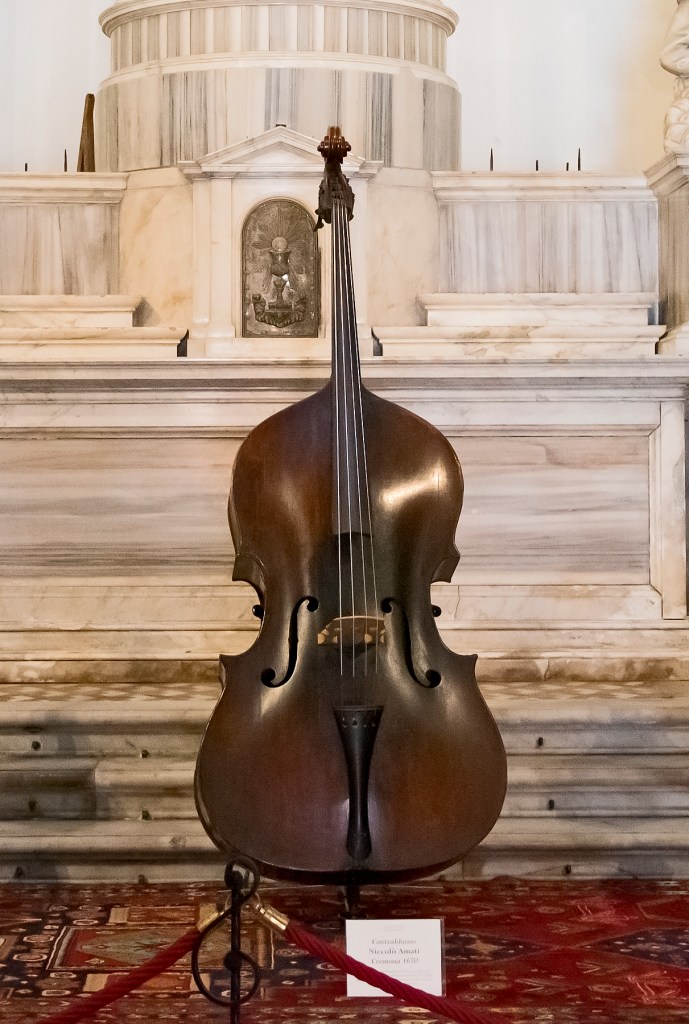
Gasparo da Salò, who worked in Brescia rather than Cremona, was not only a renowned instrument maker but also known as a performer of the violone. Basses attributed to makers such as da Salò and the Amati family often resemble the violin family in their construction: they feature rounded backs, higher shoulders, and violin-shaped outlines.(You can see the real Da Salo bass on ACO’s website)
By contrast, basses developed in the Germanic regions evolved with noticeably different characteristics. These instruments—commonly associated with traditions that later flourished in places such as Mittenwald, which remains an important center of instrument making—often retain structural elements reminiscent of the viol family. Typical features include flat backs, sloping shoulders, and body proportions closer to the viola da gamba tradition.
 윤석(Seok Yun)
Leave a comment